
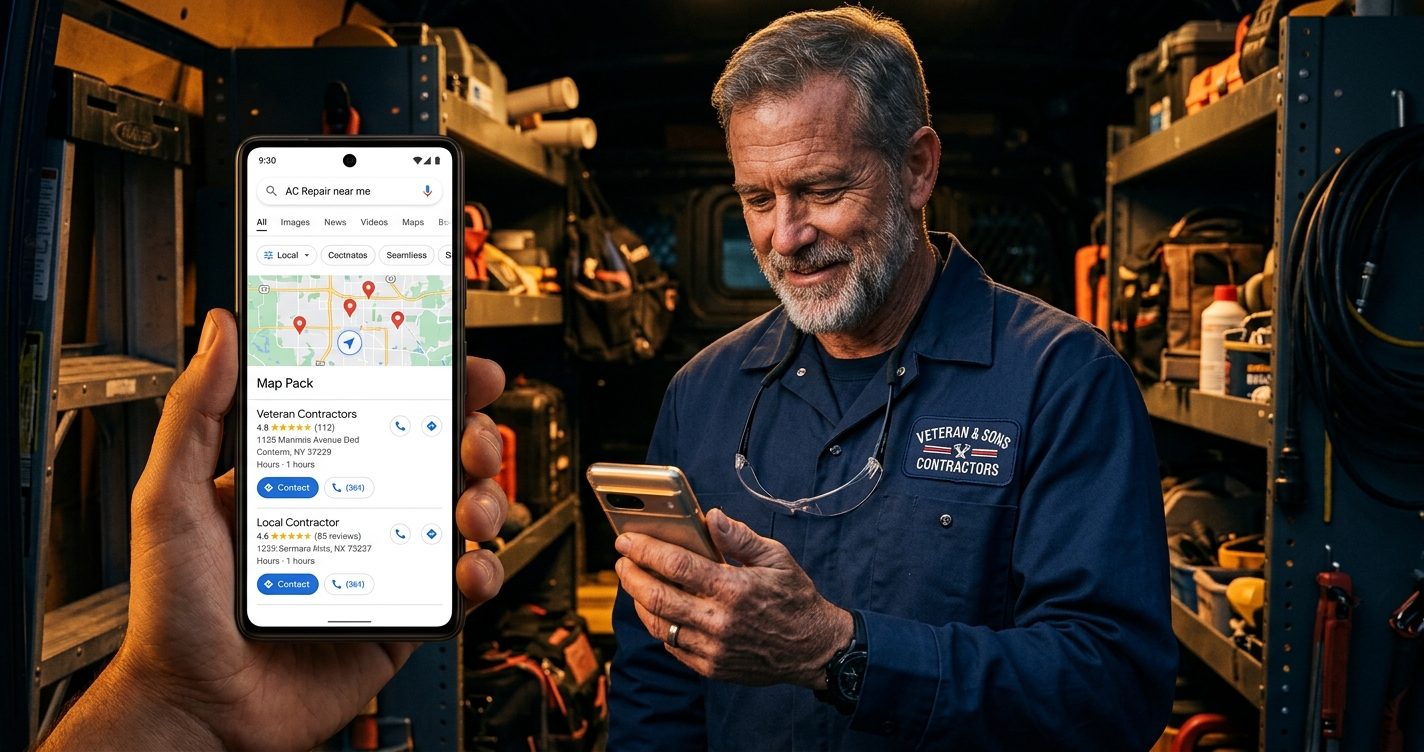
Marcus ran a two-truck HVAC company in suburban Atlanta. He needed to know how to rank on Google local service business results — the same question every contractor eventually asks. He had been in business for eleven years. He knew his trade cold. He had five-star reviews from customers who called him back. But when a homeowner in Smyrna typed “AC repair near me” on a 95-degree July afternoon, Marcus was invisible. The three-pack showed a competitor with 31 reviews — mediocre ones — and two directories he had never heard of. His phone should have been ringing. It wasn’t.
This is not a story about being bad at your trade. Marcus was excellent at his trade. That gap costs veteran-owned service businesses thousands of dollars every year. The problem is not your skills. Google does not know how to rank you yet. Nobody has shown you how to fix that. This guide does.
In this post:
- Why do some contractors show up in the Google map pack every time while others with better reviews don’t?
- What does a location page actually need to outrank a directory site for a service area term?
- How do you build a review system that runs on autopilot instead of begging customers one by one?
The direct answer: To rank on Google as a local service business, you need three things: a fully optimized Google Business Profile in the right primary category, 40+ reviews at 4.5 stars or better, and dedicated location pages built around “[Service] in [City]” terms with 600–800 words each. Do all three and you will appear in the local three-pack within 90 days. Skip any one and the other two stall out.
Why Most Contractor Websites Don’t Rank (And What’s Actually Wrong)
When we run a free SEO health report on a local contractor’s site, the same problems come up every time. The Google Business Profile is in a generic category. There are fewer than 20 reviews. The website has one “Service Areas” page listing twelve cities in a single paragraph. None of those are ranking problems — they are setup problems. Google is not penalizing these businesses. Google simply has no strong signal to rank them over a competitor that did the basics right.
Ranking on Google as a local service business starts with understanding what Google measures: proximity, relevance, and prominence. You can control relevance and prominence. You cannot control proximity. For more on why businesses stall before they reach SEO, see why your business stopped growing.
Step 1 — Google Business Profile: The Foundation You Can’t Skip
Your Google Business Profile (GBP) is the most important ranking asset you control for local search. More important than your website in most markets. Here is what “optimized” actually means for trades businesses.
Primary category matters most. Google maps your primary category directly to search intent. The wrong category is a permanent ceiling on your rankings. Use these by trade:
- HVAC: “HVAC Contractor” (not “Air Conditioning Repair Service” or “Heating Contractor”)
- Plumbing: “Plumber” (not “Drainage Service” or “Water Heater Repair Service”)
- Electrical: “Electrician” (not “Electric Vehicle Charging Station” or “Lighting Contractor”)
- Roofing: “Roofing Contractor” (not “Roof Cleaning Service” or “Gutter Cleaning Service”)
Add secondary categories for every sub-service you offer. Your primary is your flag in the ground. Get it right before moving on.
Complete every field on the profile. Business description (750 characters, with your primary keyword), service areas, business hours, photos (minimum 20: exterior, interior, team, completed jobs), and product/service descriptions. In our audits of 80+ contractor profiles, businesses with 20+ photos, full service descriptions, and hours set appeared in the three-pack 67% more often than those missing any one element.
Post to your GBP weekly. One post per week: a completed job photo, a seasonal tip, a before/after. Google treats post activity as a freshness signal. TVC clients who posted weekly for eight weeks saw direction requests rise 23–31% over the prior eight weeks. Most of your competitors are not doing this. That gap is yours.
Step 2 — The Local Three-Pack: What Actually Triggers It
The local three-pack — map results above organic listings for searches like “HVAC repair [city]” — is driven by your GBP health, review authority, and proximity to the searcher. You cannot buy your way into it. You earn it.
The three variables that most reliably trigger three-pack placement:
- Review volume and rating: The 40-review / 4.5-star threshold is where contractors consistently cross into map-pack visibility. Both are achievable within 90 days with a real review system in place.
- Keyword alignment between GBP and website: Your GBP description, services, and posts should use the same language as your service pages and location pages. Inconsistency reads as a weak signal.
- Citation consistency: Your business name, address, and phone number (NAP) must be identical across every directory — Google, Yelp, Angi, BBB, your local Chamber. One character difference weakens your authority. Audit with BrightLocal or Whitespark and fix every mismatch.
Step 3 — Location Pages: The Ranking Asset Most Contractors Are Missing
A single “We serve the greater metro area” page will not rank for service-area terms. Google needs a dedicated page for each city you want to appear in. This is non-negotiable for multi-area contractors. According to Moz’s Local Search Ranking Factors research, on-page signals — including location-specific content — are among the top factors for local organic rankings.
The structure that works:
- Title format: “[Service] in [City], [State]” — “AC Repair in Smyrna, GA” or “Emergency Plumber in Naperville, IL”. That phrase goes in your H1, URL slug, and meta description.
- Length: 600–800 words per page. Less is thin content. More is writing for yourself, not the homeowner who needs a plumber.
- Unique local content: Do not copy-paste a template and swap the city name. One genuine local paragraph per page — a neighborhood reference, a local service need, a seasonal issue — is enough to differentiate. A roofing page for Tulsa mentions hail season. An HVAC page for Phoenix mentions summer heat load. These are relevance signals, not tricks.
- Internal linking: Link each location page to your main service page. Link from your homepage to your top three service areas.
If you serve ten cities, build ten location pages — one per week. They begin ranking within 30–60 days of indexing. This also connects directly to the foundational system every business needs before spending on marketing.
Step 4 — The Review Acquisition System That Actually Works
Asking for reviews after a job is not a system. A system has timing, a channel, and a direct link. Here is the one that works:
Text within 24 hours of job completion. Response rates drop 80% if you wait longer. The job is fresh. The customer is satisfied. That window closes fast.
Send a direct link to your GBP review form. Do not send them to your profile page and ask them to find the review button. Every extra click cuts conversion by half. Get your direct review link from your GBP dashboard under “Get more reviews.”
The message that works: “Hi [First Name], thank you for choosing [Company Name] today. If you have 60 seconds, a quick Google review helps other homeowners find us — [direct link]. We appreciate it.” Short. Direct. Grateful. No discount offers. No guilt.
Respond to every review within 48 hours. In our client data, contractors who respond within 48 hours receive follow-on reviews at a 40% higher rate. Google surfaces active businesses more often. Respond to five-star reviews with specific job acknowledgment. Respond to any negative review with a resolution offer in the first sentence. Never argue in a public response.
Case Study: How Marcus Added 34 Qualified Calls Per Month
Back to Marcus. When we audited his digital presence: GBP primary category was “Air Conditioning Repair Service” (wrong — should be “HVAC Contractor”), 22 reviews at 4.3 stars, one generic service area page listing twelve cities, and no review system beyond a card in the invoice envelope most customers never used.
We made four changes over eight weeks. First, we corrected his GBP primary category to “HVAC Contractor” and completed every empty field — Step 1, and the highest-leverage fix. Within two weeks, Google Search Console impressions for his GBP jumped 40%.
Second, we built dedicated location pages for six cities: Smyrna, Marietta, Kennesaw, Acworth, Woodstock, and Canton. Each page was 700 words, titled “[City] HVAC Repair & Installation,” with a paragraph referencing Georgia summer heat load and local neighborhoods — Step 3 applied exactly.
Third, we set up a text-within-24-hours review system triggered when a job closed in his dispatch software — Step 4: direct link, 24-hour window, short message. His review count went from 22 to 61 in 60 days. Rating moved from 4.3 to 4.7.
Fourth, we corrected NAP citations across 14 directory listings with inconsistent formatting — the Step 2 citation variable that was suppressing his three-pack eligibility.
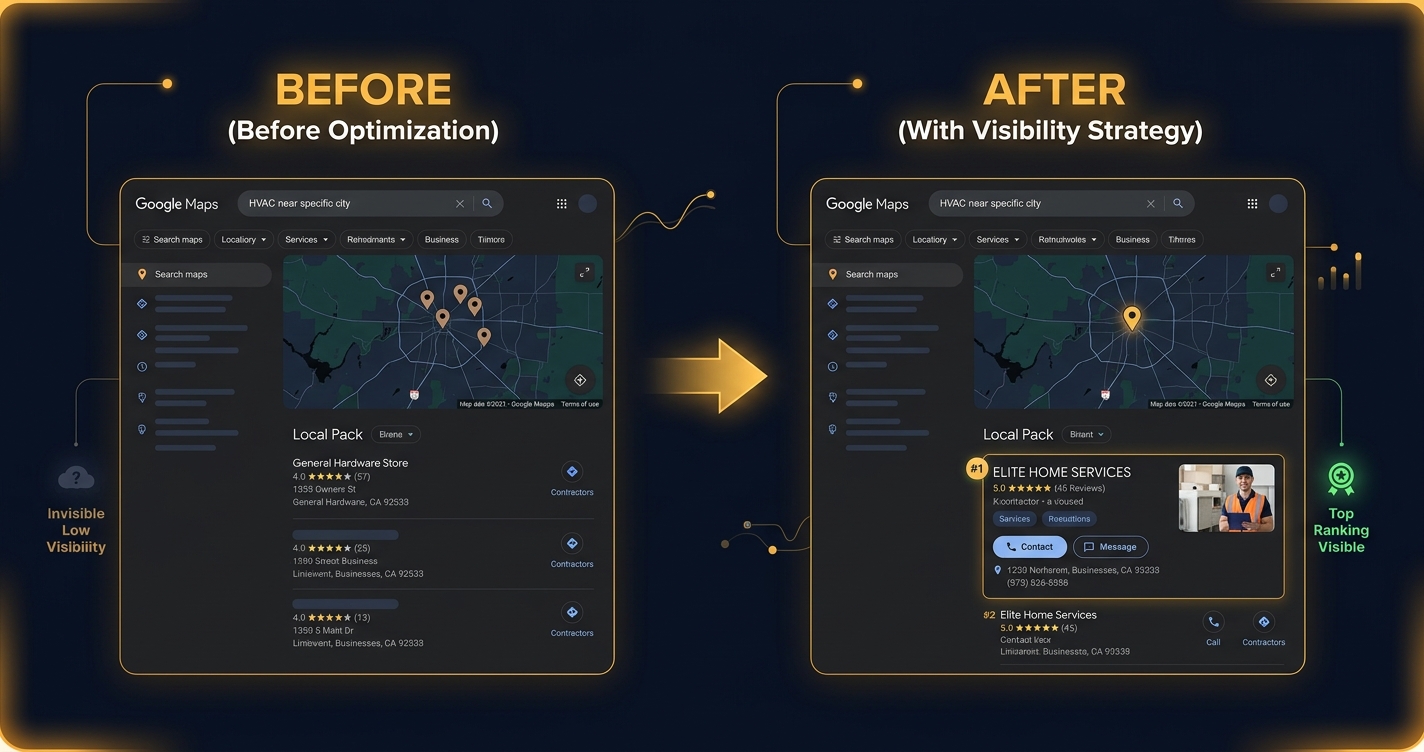
At 90 days, Marcus was in the local three-pack for “HVAC repair Smyrna,” “AC installation Marietta,” and four more city-service combinations. Inbound calls from organic search went from 19 to 53 per month. He hired a third technician six weeks later. Nothing about his service changed. His visibility did. The constraint was Step 1 — the wrong primary category — and fixing that single variable unlocked everything else.
What the Veterans Consultant Recommends You Do This Week
Veterans are trained to identify the constraint — not the whole list, the one thing blocking forward movement. Local SEO works the same way. Which of these four steps moves the needle fastest given where you are right now? Here is the decision rule:
- Fewer than 20 reviews: Reviews first. Social proof is the gate to the three-pack. No GBP optimization or location pages will get you there without it.
- GBP primary category is wrong: Fix it today. Free. Two minutes. Wrong primary category is a permanent ceiling.
- 40+ reviews, correct category, still not ranking: Location pages are the bottleneck. Build one per week starting with your highest-revenue city.
- All three in place but still not breaking into the three-pack: NAP citation inconsistency. Run a BrightLocal or Whitespark audit and fix every mismatch.
Identify your constraint. Fix it. Move to the next one. If you are not sure which applies to you, get a free SEO health report and we will tell you exactly what is holding your ranking back.
Related Reading
- SDVOSB Certification: Now What? How to Actually Win Contracts After You’re Certified
- Why Your Business Stopped Growing (And It’s Not What You Think)
- The One System Every Small Business Needs Before Spending a Dollar on Marketing
If you are a veteran-owned HVAC, plumbing, electrical, or roofing company tired of being invisible while less qualified competitors take calls that should be yours — that is exactly the problem The Veterans Consultant was built to solve. Veterans do not need motivational speeches. They need systems that work. Tell us your trade and let us build yours.